


Scientists explain why your brain keeps craving snacks — even when your body is full
You just ate. A full meal. Enough calories. Enough volume. Enough to physically say, “I’m done.” And yet… ten minutes later, you’re opening the fridge again.
This isn’t a lack of discipline. And according to new research in behavioral neuroscience, it’s not even really a decision. It’s a system. A system that doesn’t shut off when you think it should.
The uncomfortable fact: fullness doesn’t stop desire
Researchers studying human eating behavior have been circling this problem for years, but recent experimental data has made one thing increasingly clear:
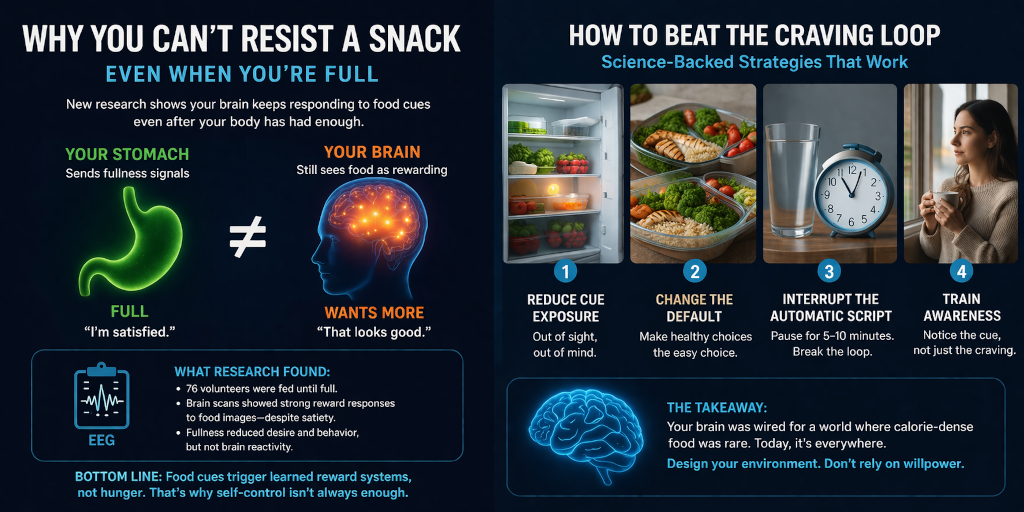
Your brain and your stomach are running two different programs.
In controlled lab settings, participants are fed until they report complete satiety — no hunger, no desire to eat more. Behaviorally, they stop choosing food. They say they don’t want it.
But when scientists measure brain activity — especially in regions associated with reward and motivation — the response to food cues remains active.
Dr. Thomas Sambrook, a cognitive neuroscientist involved in this line of research, described it bluntly in a report:
“Even when the body signals that it has had enough, the brain continues to treat food cues as highly rewarding.”
Translation: your stomach says stop. Your brain says opportunity.
And the brain often wins.
This isn’t hunger — it’s learned reward
If this were just about hunger, the mechanism would be simple:
- You’re hungry → food looks good
- You’re full → food looks less appealing
But that’s not what happens. Instead, the brain appears to rely on learned associations — patterns built over years of repeated exposure.
Chocolate = reward
Chips = reward
Late-night snack = comfort
Movie = popcorn
These associations don’t disappear when you’re full. They operate more like habits than needs. In neuroscience terms, this is often linked to cue-triggered reward processing — a system where external signals (images, smells, contexts) activate neural pathways regardless of internal energy state.
The modern environment is designed to exploit this
Now zoom out. Because this isn’t happening in a vacuum. We don’t live in environments where food is scarce and signals are rare. We live in environments where food cues are constant, engineered, and unavoidable.
- Ads showing high-calorie foods every few minutes
- Bright packaging designed to trigger attention
- Social media filled with visually optimized meals
- Smells from bakeries, cafes, street food
From a biological perspective, this is completely unnatural. For most of human history, high-calorie food was rare. The brain evolved to treat it as valuable. Hard to find. Worth pursuing. Now it’s everywhere. And the brain hasn’t updated the software.
Why self-control isn’t the full answer
This is where most advice breaks down.
“Just use willpower.”
“Just eat less.”
“Just be disciplined.”
The data doesn’t support that as a complete solution. In fact, studies show that even individuals with strong executive control — the ability to make goal-directed decisions — still exhibit persistent neural responses to food cues.
In other words:
You can know you shouldn’t eat it.
You can decide not to eat it.
And your brain will still fire signals telling you it’s rewarding.
That creates a constant internal conflict.
A small mismatch with massive consequences
Individually, one extra snack doesn’t matter much. But zoom out again. This mechanism — cue-driven eating independent of hunger — scales. Daily. Weekly. Over years.
That’s where things shift from behavior to public health. Global obesity rates have increased dramatically over the past few decades, and researchers increasingly point to environmental cue overload as a major driver — not just caloric availability. Because it’s not just about how much food exists. It’s about how often your brain is told to want it.
So what actually helps?
If the system is automatic, the strategy has to change. Here’s what current behavioral science suggests actually works:
1. Reduce exposure to cues
This is the highest-leverage move. If cues trigger the response, fewer cues = fewer triggers.
- Keep snacks out of immediate visibility
- Avoid storing high-reward foods in easy reach
- Limit exposure to food-heavy media when possible
You’re not “weak” for wanting it. You’re human for responding to it.
2. Change the default environment
Make the easier choice the better choice.
- Pre-plan meals
- Keep lower-calorie options readily available
- Structure eating times instead of grazing
The brain is highly responsive to what’s convenient. So control convenience.
3. Interrupt the automatic script
Remember: much of this is habitual. So even a small pause matters.
- Wait 5–10 minutes before acting on a craving
- Drink water first
- Shift context (stand up, move, change rooms)
4. Train awareness, not restriction
People often try to suppress cravings completely. That tends to backfire. A more effective approach is recognizing: “This is a cue-triggered response, not actual hunger.” That distinction alone reduces impulsive behavior. Because now you’re observing the system, not being run by it.
What this means going forward
The bigger takeaway isn’t just about snacks. It’s about how human behavior works in modern environments. We like to think of ourselves as rational decision-makers. But in many cases, we’re responding to learned signals faster than conscious thought can intervene. Food is just one domain where this becomes visible. And measurable.
So the real question isn’t:
“Why can’t I resist this?”
It’s:
“What system am I operating in — and how is it shaping my behavior?”
Because once you see it that way, the strategy changes. You stop blaming yourself. You start redesigning the inputs.